

Saturday, June 21, 2008

 but when my people throw it into the water, there is only one way to get it----to swim. And so, I have grudgingly learned to swim.


Wednesday, June 11, 2008
Cicada Songs
"They sound like a thousand cars with bad power steering, all turning in tight little circles." At least, that's what one of my humans said to the other. They were talking about cicadas--periodical cicadas--and they have emerged on Cape Cod. In our town, there are not a lot of them. However, in the next town over, the sound can be deafening. Cicadas made the front page of today's Cape Cod Times. They were discribed as "what sounds like a chorus of police and fire sirens headed to a massive accident." http://www.capecodonline.com/_images/pdf/a1.pdf --


(To see the front page of the Cape Cod Times, go to: http://www.capecodonline.com/apps/pbcs.dll/section?category=NEWS)
-----------------------------------------
A couple of days ago, I witnessed a curious phenomenon: my human partner was outdoors with this small, odd-looking box that occasionally made clicking noises. She was staring at one of those cicada bugs that there has been so much fuss about. Then she found something on a tree to stare at. Afterwards, she started working on the computer and a bunch of different cicada pictures came up on the computer screen. I thought they were rather interesting, so here they are.


----------------------------------
"....No other insects in North America excite as much curiosity and wonder as do periodical cicadas when they make their sudden appearance every 13 or 17 years. These cicadas are widely distributed in the United States east of the Rocky Mountains, but occur nowhere else on earth. There are seven species of periodical cicadas—four with 13-year life cycles and three with 17-year life cycles, distributed over several broods (see map below). The best way to identify individual species is by sound because each cicada song is species specific. After years of living in underground tunnels, thousands of periodical cicadas emerge from the earth, as if by a predetermined signal, shed their nymphal skins, and spread out through the nearby trees and bushes. Up to 40,000 can emerge from a under a single tree!
The cicada's precise but prolonged time schedule revolves around survival for the masses. When a large population of juicy insects appears on the scene, predators make the most of the situation, but simply cannot eat all the insects. Thus, a significant number of cicadas live to reproduce. Long-lived predators may actually remember the feast and return to the scene in subsequent years. Short-lived predators, being well fed from the cicada banquet, reproduce successfully and often leave a larger population to await next year’s emergence. However, "next year" doesn’t happen for at least 13 years, so the periodical cicada is able to outlast and escape most of its enemies.
From morning till night the males fill the air with their loud, droning song. The song is like the familiar sound of the common dog-day cicada so typical of summer evenings, only it is louder and heard at the end of spring. The males are the only ones singing...." [From: "A Trill of a Lifetime"(originally published in The Illinois Steward, Summer 2004)text by Susan L. Post. For complete text, go to: http://www.inhs.uiuc.edu/highlights/periodicalCicada.html]
-------------------
"What is a periodical cicada?
Cicadas are flying, plant-sucking insects of the Order Hemiptera; their closest relatives are leafhoppers, treehoppers, and fulgoroids. Adult cicadas tend to be large (most are 25-50mm), with prominent wide-set eyes, short antennae, and clear wings held roof-like over the abdomen. Cicadas are probably best known for their conspicuous acoustic signals or "songs", which the males make using special structures called tymbals, found on the abdomen. There may be as many as 3000 different cicada species worldwide.
All but a few cicada species have multiple-year life cycles, most commonly 2-8 years (de Boer and Duffels 1996). In most cicada species, adults can be found every year because the population is not developmentally synchronized; these are often called "annual" cicada species. In contrast, populations of the periodical cicada species are synchronized, so that almost all of them mature into adults in the same year. The fact that periodical cicadas remain locked together in time is made even more amazing by their extremely long life-cycles of 13 or 17 years.
Periodical cicadas are found in eastern North America and belong to the genus Magicicada. There are seven species -- four with 13-year life cycles (including one new species described in 2000), and three with 17-year cycles. The three 17-year species are generally northern in distribution, while the 13-year species are generally southern and midwestern. Magicicada are so well-synchronized developmentally that they are nearly absent as adults in the 12 or 16 years between emergences. When they do emerge after their long juvenile periods, they do so in huge numbers, forming much denser aggregations than those usually achieved by cicadas. Many people know periodical cicadas by the name "17-year locusts" or "13-year locusts", but they are not true locusts, which are a type of grasshopper.
Magicicada adults have black bodies and striking red eyes and orange wing veins, with a black "W" near the tips of the forewings. Most emerge in May and June. Some of the annual cicada species are sometimes mistaken for the periodical cicadas, especially those in the genera Diceroprocta and Okanagana; these other species emerge somewhat later in the year but may overlap with Magicicada. The Okanagana species are the most potentially confusing because of their similar black-and-orange coloration. The best way to identify cicada species is by the sounds that they make, because cicada songs are nearly always species-specific. ----------------
Magicicada life cycles
Cicada juveniles are called "nymphs" and live underground, sucking root fluids for food. Periodical cicadas spend five juvenile stages in their underground burrows, with each stage ending with eclosion (shedding of the old nymphal skin). Their burrows are found anywhere from several inches to a few feet underground, depending on nymphal age and the nature of the soil.
In the spring of their 13th or 17th year, a few weeks before emerging, the nymphs construct exit tunnels to the surface. These exits are visible as approximately 1/2 inch diameter holes, or as chimney-like mud "turrets" the nymphs sometimes construct over their holes. On the night of emergence, nymphs leave their burrows around sunset, locate a suitable spot on nearby vegetation, and complete their final molt to adulthood. Shortly after ecdysis (molting) the new adults appear mostly white, but they darken quickly as the exoskeleton hardens. Sometimes a large proportion of the population emerges in one night. Newly-emerged cicadas work their way up into the trees and spend roughly four to six days as "teneral" adults before they harden completely (possibly longer in cool weather); they do not begin adult behavior until this period of maturation is complete.
It appears that the particular night of emergence may be determined by the soil temperature; nymphs emerge when the soil temperature inside the exit tunnel (and therefore the body temperature of the nymph) exceeds approximately 64 degrees F (Heath 1968). Because emergence is temperature- dependent, periodical cicadas tend to emerge earlier in southern and lower-elevation locations. For example, periodical cicadas in South Carolina often begin to emerge in late April, while those in southern Michigan do not appear until June. The best way to predict the time of emergence for your area is to check records from the prior emergence in that location, by asking longtime residents or by searching local newspaper archives. The date of emergence does not vary much between generations, although unusual springtime weather conditions may accelerate or delay the emergence by a week or so.
After their short teneral period, males begin producing species-specific calling songs and form aggregations (choruses) that are sexually attractive to females. Males in these choruses alternate bouts of singing with short flights until they locate receptive females (see the Magicicada behavior section below). Contrary to popular belief, adults do feed -- by sucking plant fluids; adult cicadas will die within days if not provided with living woody vegetation on which to feed. Magicicada feed from a wide variety of deciduous plants and shrubs, but usually not from grasses.... Mated females excavate aseries of Y-shaped eggnests in living twigs and lay up to twenty eggs in each nest (Marlatt 1923). A female may lay as many as 600 eggs (Marlatt 1923)....
Why are there so many of them?
Periodical cicadas achieve astounding population densities, as high as 1.5 million per acre (Dybas 1969). Densities of tens to hundreds of thousands per acre are more common, but even this is far beyond the natural abundance of most other cicada species. Apparently because of their long life cycles and synchronous emergences, periodical cicadas escape natural population control by predators, even though everything from birds to spiders to snakes to dogs eat them opportunistically when they do appear. Magicicada population densities are so high that predators apparently eat their fill without significantly reducing the population (a phenomenon called "predator satiation"), and the predator populations cannot build up in response because the cicadas are available as food above ground only once every 13 or 17 years. Periodical cicadas do have a specialized fungal parasite (see the Magicicada diseases and deformities section), but its effects on Magicicada population density are not well understood. Individual periodical cicadas are slower, less flighty, and easier to capture than other cicadas, probably because the safety afforded by their great numbers means that the risks of predation for an individual are low. Explaining the evolution of such an unusual life strategy is one of the most difficult problems for periodical cicada biologists.
This year (2008), the large Appalachian 17-year Brood XIV will appear. As is true for most of the 17-year broods, all three 17-year species will be present in many locations. A web-based effort to map the distribution of this brood in more detail is underway.... Sometimes periodical cicadas emerge "off-schedule" by one or more years. This phenomenon is called "straggling," although straggling cicadas can emerge either later or earlier than expected. The most common form of straggling is one-year premature or delayed emergences, usually involving small numbers of cicadas. Unexpectedly, the next most common form of off-schedule emergence is four-year premature appearances by 17-year cicadas, and these events sometimes involve many thousands at once. In 2000, many cicadas emerged four-years early across the range of Brood X. A similar event was observed in 1969 in the Chicago area, four years before the normal emergence in 1973 (Dybas 1969). These events help us to understand the origin of the various same-cycle broods as well as the developmental mechanisms underlying Magicicada speciation, which tends to involve permanent shifts between life cycle types (see details on the seven species and their relationships below). Straggling makes it difficult to construct accurate maps of periodical cicada brood distributions (Marshall 2001), partly because historical reports of off-schedule emergences often contain little or no information about how many cicadas were seen.
Magicicada behavior
As in nearly all cicada species, male periodical cicadas produce "songs" using a pair of tymbals, or ridged membranes, found on the first abdominal segment. The abdomen of a male cicada is hollow and may act as a resonating chamber; the songs of individuals are loud, and large choruses can be virtually deafening. Females of most cicada species do not have sound-producing organs. Both sexes hear the sounds of the males as well as other sounds using membranous hearing organs called "tympana" found on the underside of the abdomen.
Over the course of an emergence, males congregate in "choruses" or singing aggregations, usually in high, sunlit branches. Females visit these aggregations and mate there, so choruses contain large numbers of both sexes.
Males of all Magicicada species (each described individually below in the Magicicada species section) produce alarm calls when handled, calling songs that attract males and females to the chorus, and one or more courtship calls when approaching and attempting to mate with females. Five different male acoustic signals have been described for the -decim and -cassini cognate species. Samples of most of these sounds are included below. These species have calling and courting signals that differ in pitch (frequency) and other characteristics, but the signals have have similar structures, so they can be described together. The functions of these signals are not entirely understood, but they have been given names to indicate their suspected function. The acoustical behaviors of the -decula species have not been as well characterized.
Female Magicicada produce timed "wing flick" signals in response to male calls, and the timing of this signal in relation to the male call is species-specific for species of the same life cycle. The signal consists of a quick flip of the wings that creates a broad-frequency sound that can vary from a soft rustle to a sharp snap. Males are able perceive both the visual and acoustic components of the wing-flick.
A chorusing male perceiving a female signal increases his number of calls relative to movement distance, increasing the odds that he will elicit further responses from any nearby female. If the male receives multiple responses, he ceases sing-fly behavior, begins CI courtship, and engages in a signaling duet with the wing flicking female, evidently for the purpose of locating her. Between calls, duetting males often walk towards the signaling female, and while approaching, begin CII calling. After contacting the female or while preparing to mount, the male begins CIII calling, which he continues until he mounts and copulates. Under some circumstances, males engaged in duets acoustically obscure the downslurs of potential competitors, reducing the likelihood of a female response and increasing the likelihood that competing males will continue chorusing, depart and search elsewhere. Although female wing-flick signaling is known in some Australian and New Zealand cicadas (e.g., Lane 1995), this is the first reported incidence of female signaling in North American cicadas.... " [For complete text, go to: http://insects.ummz.lsa.umich.edu/fauna/Michigan_Cicadas/Periodical/Index.html]
For pictures of the May 29th, 2008 Cicada Brood: http://www.flickr.com/photos/rotcav/2535636246/
If you now have "Cicada Mania," go to: http://www.cicadamania.com/cicadas/
Sunday, June 1, 2008
Happy Birthday!
 Today, June 1, 2008, is my second birthday. Why humans make such a big deal of birthdays is quite beyond me. Nevertheless, my personal humans felt the need to have me wear a birthday hat, in spite of the fact that it actually stayed on top of my head no more than 3 seconds! So, here I am, showing what a good sport I can be. However, do note the ears...........
Friday, May 16, 2008
"Bloat - The Mother of All Emergencies"
Ginny thought that this was a very important article to post. It was published on VeterinaryPartner.com In order to view the excellent images that go along with this article, go directly to the web address listed below.
Title: Bloat - The Mother of All Emergencies
Source: The Pet Health Care Library
Authors:
Address (URL): http://www.VeterinaryPartner.com/Content.plx?P=A&A=672
There are many injuries and physical disorders that represent life-threatening emergencies. There is only one condition so drastic that it overshadows them all in terms of rapidity of consequences and effort in emergency treatment. This is the gastric dilatation and volvulus - the bloat.
What is it and Why is it so Serious?
The normal stomach
The normal stomach sits high in the abdomen and contains a small amount of gas, some mucus, and any food being digested. It undergoes a normal rhythm of contraction, receiving food from the esophagus above, grinding the food, and meting the ground food out to the small intestine at its other end. Normally this proceeds uneventfully except for the occasional burp.
 In the bloated stomach, gas and/or food stretches the stomach many times its normal size, causing tremendous abdominal pain. For reasons we do not fully understand, this grossly distended stomach has a tendency to rotate, thus twisting off not only its own blood supply but the only exit routes for the gas inside.
  Not only is this condition extremely painful but it is also rapidly life-threatening. A dog with a bloated, twisted stomach (more scientifically called gastric dilatation and volvulus) will die in pain in a matter of hours unless drastic steps are taken.
What are the Risk Factors for Developing Bloat?
Classically, this condition affects dog breeds that are said to be deep chested, meaning the length of their chest from backbone to sternum is relatively long while the chest width from right to left is narrow. Examples of deep chested breeds would be the Great Dane, Greyhound, and the setter breeds. Still, any dog can bloat, even dachshunds and Chihuahuas. Dogs weighing more than 99 pounds have an approximate 20% risk of bloat
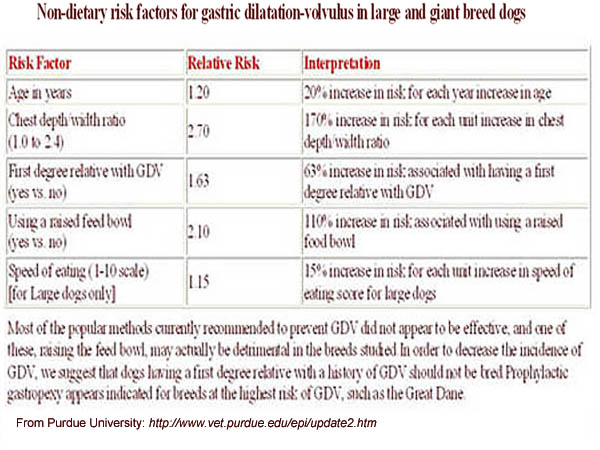
Classically, a dog who bloated had eaten a large meal and exercised heavily shortly thereafter. Still, we usually do not know why a given dog bloats on an individual basis. No specific diet or dietary ingredient has been proven to be associated with bloat. Some factors found to increase and decrease the risk of bloat are listed below:
Factors Increasing the Risk of Bloating Feeding only one meal a day Having closely related family members with a history of bloat Eating rapidly Being thin or underweight Moistening dry foods (particularly if citric acid is listed as a preservative) Feeding from an elevated bowl Restricting water before and after meals Feeding a dry diet with animal fat listed in the first four ingredients Fearful or anxious temperament History of aggression towards people or other dogs Male dogs are more likely to bloat than females Older dogs (7 - 12 years) were the highest risk group
Factors Decreasing the Risk of Bloat Inclusion of canned dog food in the diet Inclusion of table scraps in the diet Happy or easy-going temperament Feeding a dry food containing a calcium-rich meat meal (such as meat/lamb meal, fish meal, chicken by-product meal, meat meal, or bone meal) listed in the first four ingredients of the ingredient list. Eating two or more meals per day
Contrary to popular belief, the presence of cereal ingredients such as soy, wheat or corn in the first four ingredients of the ingredient list does not increase the risk of bloat.
In a study done by the Perdue University Research Group, headed by Dr. Lawrence T. Glickman:
The Great Dane was the number one breed at risk for bloat.
The St. Bernard was the number two breed at risk for bloat.
The Weimaraner was the number three breed at risk for bloat.
A study by Ward, Patonek, and Glickman reviewed the benefit of prophylactic surgery for bloat. Prophylactic surgery amounts to performing the gastropexy surgery (see below) in a healthy dog, usually in conjunction with spay or neuter. The lifetime risk of death from bloat was calculated, along with estimated treatment for bloat, versus cost of prophylactic gastropexy. Prophylactic gastropexy was found to make sense for at-risk breeds, especially the Great Dane, which is at highest risk for bloat.
How to Tell if Your Dog has Bloated
Radiograph showing typical gas distension of the stomach in a case of bloat The dog may have an obviously distended stomach, especially near the ribs, but this is not always evident depending on the dog's body configuration.
The biggest clue is the vomiting: the pet appears highly nauseated and is retching but little is coming up.
If this is seen, rush your dog to the veterinarian IMMEDIATELY.
What has to be Done
There are several steps to saving a bloated dogs life. Part of the problem is that all steps should be done at the same time and as quickly as possible.
First: The Stomach must be Decompressed
The huge stomach is by now pressing on the major blood vessels carrying blood back to the heart. This stops normal circulation and sends the dog into shock. Making matters worse, the stomach tissue is dying because it is stretched too tightly to allow blood circulation through it. There can be no recovery until the stomach is untwisted and the gas is released. A stomach tube and stomach pump are generally used for this but sometimes surgery is needed to achieve stomach decompression.
Also First: Rapid Intravenous (IV) Fluids must be Given to Reverse the Shock
Intravenous catheters are placed and life-giving fluid solutions are rushed in to replace the blood that cannot get past the bloated stomach to return to the heart. The intense pain associated with this disease causes the heart rate to race at such a high rate that heart failure will result. Medication to resolve the pain is needed if the patient's heart rate is to slow down. Medication for shock, antibiotics, and electrolytes are all vital in stabilizing the patient.
Also First: The Heart Rhythm is Assessed and Stabilized
There is a specific, very dangerous rhythm problem called a premature ventricular contraction or "PVC" that is associated with bloat and it must be ruled out. If it is present, IV medications are needed to stabilize the rhythm. Since this rhythm problem may not be evident until even the next day, continual EKG monitoring may be necessary. A disturbed heart rhythm that is already seen at the beginning of treatment is associated with a 38% mortality rate.
Getting the bloated dog's stomach decompressed and reversing the shock is an adventure in itself but the work is not yet half finished.
Surgery
All bloated dogs, once stable, should have surgery. Without surgery, the damage done inside cannot be assessed or repaired plus bloat may recur at any point, even within the next few hours and the above adventure must be repeated. Surgery, called gastropexy, allows the stomach to be tacked into normal position so that it may never again twist. Without gastropexy, the recurrence rate of bloat may be as high as 75%!
Assessment of the internal damage is also important to recovery. If there is a section of dying tissue on the stomach wall, this must be discovered and removed or the dog will die despite the heroics described above. Also, the spleen, which is located adjacent to the stomach, may twist with the stomach. The spleen may also need to be removed.
If the tissue damage is so bad that part of the stomach must be removed, the mortality rate jumps to 28 to 38%.
If the tissue damage is so bad that the spleen must be removed, the mortality rate is 32 to 38%.
After the expense and effort of the stomach decompression, it is tempting to forgo the further expense of surgery. However, consider that the next time your dog bloats, you may not be there to catch it in time and, according the study described below, without surgery there is a 24% mortality rate and a 76% chance of re-bloating at some point. The best choice is to finish the treatment that has been started and have the abdomen explored. If the stomach can be surgically tacked into place, recurrence rate drops to 6%.
Results of a Statistical Study
In 1993, a statistical study involving 134 dogs with gastric dilatation and volvulus was conducted by the School of Veterinary Medicine in Hanover, Germany.
Out of 134 dogs who came into the hospital with this condition: 10% died or were euthanized prior to surgery (factors involved included expense of treatment, severity/advancement of disease, etc.) 33 dogs were treated with decompression and no surgery. Of these dogs, 8 (24%) died or were euthanized within the next 48 hours due to poor response to treatment. (Six of these 8 had actually re-bloated) Of the dogs that did not have surgical treatment but survived to go home, 76% eventually had another episode of gastric dilatation and volvulus. 88 dogs were treated with both decompression and surgery. Of these dogs, 10% (9 dogs) died in surgery, 18% (16 dogs) died in the week after surgery, and 71.5% (63 dogs) went home in good condition. Of the dogs that went home in good condition, 6% (4 dogs) had a second episode of bloat later in life. In this study, 66.4% of the bloated dogs were male and 33.6% were female. Most dogs were between ages 7 and 12 years old. The German Shepherd dog and the Boxer appeared to have a greater risk for bloating than did other breeds.
(Meyer-Lindenberg A., Harder A., Fehr M., Luerssen D., Brunnberg L. Treatment of gastric dilatation-volvulus and a rapid method for prevention of relapse in dogs: 134 cases (1988-1991) Journal of the AVMA, Vol 23, No 9, Nov 1 1993, 1301-1307.)
Another study published December of 2006 looked at 166 dogs that received surgery for gastric dilatation and volvulus. The point of the study was to identify factors that led to a poor prognosis. A 16.2% mortality rate was observed. The mortality rate for dogs over age 10 years was 21%. Of the 166 going to surgery, 4.8% were euthanized during surgery, and the other 11.4% died during hospitalization (2 of dogs died during surgery). All dogs that survived to go home were still alive at the time of suture removal. 34 out of 166 dogs had gastric necrosis (dead stomach tissue that had to be removed). Of these dogs 26% died or were euthanized. Post-operative complications of some sort occurred in 75.9% of patients. Approximately 50% of these dogs developed a cardiac arrhythmia. Risk factors significantly associated with death prior to suture removal included clinical signs of bloating for greater than 6 hours before seeing the vet, partial stomach removal combined with spleen removal, need for blood transfusion, low blood pressure at any time during hospitalization, sepsis (blood infection), and peritonitis (infection of the abdominal membranes).
(Beck, J.J., Staatz, A.J., Pelsue, D.H., Kudnig, S.T., MacPhail, C.M., Seim H.B, and Monnet, E. Risk factors associated with short-term outcome and development of perioperative complications in dogs undergoing surgery because of gastric dilatation-volvulus: 166 cases (1992-2003). Journal of the AVMA, Vol 229, No 12, December 15, 2006, p 1934-1939.)
In is crucially important that the owners of big dogs be aware of this condition and prepared for it. Know where to take your dog during overnight or Sunday hours for emergency care. Avoid exercising your dog after a large meal. Know what to watch for. Enjoy the special friendship a large dog provides but at the same time be aware of the large dog's special needs and concerns.
Copyright 2007 - 2008 by the Veterinary Information Network, Inc. All rights reserved.
Sunday, May 4, 2008
"ASK GINNY"

Ginny invites you to write to her with your questions...... [Submit them as a comment on one of the "Ask Ginny" posts and Ginny will repost them in a new post segment.]
Q & A about health, veterinary
matters, training, and life
Q: Dear Ginny,
I have heard rumors that there have been some problems with a dental chew bone that goes by the name of Greenies. What are these problems and are they true or just an exaggeration?
A: There is truth to at least one of these rumors--that there are cases where a Greenie, or a piece of it, has caused an obstruction of the esophagus, which is the tube that takes food from the throat to the stomach. An article in the April 1, 2008, issue of the Journal of the American Veterinary Medical Association (JAVMA) described "Esophageal foreign body obstruction caused by a dental chew treat in 31 dogs (2000-2006)."[1] This article evaluated 30 cases between March 2003 and January 2006, and one case from July 2000. All were evaluated either at a university teaching hospital or a private specialty hospital. Each dog included in this retrospective study had been given the treat shortly before onset of clinical signs and a green object was identified during endoscopy or surgery. All but four of the dogs were small dogs. In all but one of the 31 dogs, there was moderate to severe damage to the esophagus. Five dogs required surgery to open the chest. Complications of the esophageal damage were seen up to 25 days after diagnosis. Of the 31 dogs treated, only 15 dogs recovered without major complications. Six of the 31 dogs (or 25.8%) died or were euthanized as a direct result of the esophageal obstruction caused by the chew treat.
Certainly Greenies[2] are not the only treat, chew toy, or other material, that can cause damage or obstruction to the esophagus in dogs (or cats). The JAVMA article states that "Bones are the most common esophageal foreign bodies that have been reported in dogs, although fish-hooks, rawhide, pieces of plastic or metal, and other miscellaneous objects have been described. Small breeds of dogs are often affected. Common clinical signs include regurgitation [3] or vomiting, anorexia [or loss of appetite], salivation, and signs of depression [or listlessness]. Esophageal obstructive foreign bodies, such as bones, most commonly lodge in the distal portion of the esophagus [closest to the stomach], whereas the second most common location is at the level of the heart base. Diagnosis is usually made via ... radiography." The article goes on to say that, in 2004, Greenies "received the seal of acceptance for plaque and tartar removal from the Veterinar Oral Health Council of the American Veterinary Dental College." The Greenies web site reported sales over over 300 million of the chew treats in 2005, but,in June 2005, a group discussion sponsored by the Comparative Gastroenterology Society at the Medical Forum of the ACVIM [American College of Veterinary Internal Medicine] decribed difficulty in removing the esophageal obstructions caused by the dental treats, so further investigation was pursued.
It would seem logical that ANY hard chew treat that could break off pieces are large enough to get stuck in the esophagus, especially if they have corners or sharp edges, should not be given to dogs to chew on. One suggestion is to do some on-line investigation of a treat before you give it to your dog, regardless of how wonderful a manufacturer makes it sound.
[1] "Esophageal foreign body obstruction caused by a dental chew treat in 31 dogs (200-2006)," Michael S. Leib, DVM, MS DACVIM, and Laura Lee Sartor, DVM, DACVIM; published in JAVMA, Vol 232, No. 7, April 1, 2008, p.1021
[2] Greenies, S&M NuTec LLC, North Kansas City, Mo.
[3] "Regurgitation" = passive expulsion of ingested material from the mouth. It differs from vomiting, in that vomiting is an active process.
[Disclaimer: Any advice (or implied advice) found on this blog is no substitute for the clinical relationship that your pet has with his/her own veterinarian. You should ALWAYS seek the advice of your veterinarian before making any decisions about the health care of your pet.]
Subscribe to:
Posts (Atom)
My Favorite Facebook Page! I am SUCH a Fan (I'm also their mascot!)