
Wednesday, May 27, 2009
Puppy Cam--Cavalier King Charles Spaniels
Check out these new puppies on live camera: http://www.sacpaws.com/#video


Wednesday, May 6, 2009
Week #3 of Obedience Class
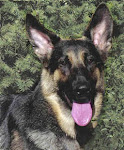
First, let it be said that I am really a very clever dog. I understand all sorts of phrases and words--things that my people never even taught me--I just figured out their meaning by simple observation. For example, If one of my people says to the other, "I am getting sleepy," it doesn't take a genius to figure out that I might as well go to my crate, because they are about to go to bed. My people already know that I am smart. I do not know why th ey thought I needed to go to school to prove it to other people, too.
As I understand it, they want me to obey their commands when I am in public. I, myself, do not understand this. When I am in public, I feel a great compulsion to protect my people against what I perceive to be danger. The whole world outside makes me quite nervous. I do not trust strange dogs or strange people. Therefore, I feel that it is my responsibility to act tough and warn them that they better not come too close. For some incomprehensible reason, this makes my people very unhappy. When I bark or do my warning "woof-and-bounce" that is meant to make me look threatening, they speak quite harshly to me. I initially assumed that their displeasure meant that I did not do my job properly. Now that I have started going to dog class, I am beginning to figure out that the rules of social behavior are not quite what I had originally thought. This is going to require a good bit of getting used to.
I had a very quiet early puppyhood. I lived with my breeder and my brother until I was 10 months of age. It was a peaceful life. There were other German shepherds around, but my brother (who was always bigger than I was, and kept me safe from danger) was my constant companion. I loved my breeder and her granddaughter, who would come and brush me and walk me around on a leash. Sometimes I would go to see another human relative, but I never had to interact with strange people or dogs. I was happy this way. My current humans had sent some of their clothing for me to sleep with before they came to take me to my new home, so that when we first met, I felt like I had known them already. My new home was very peaceful, too, and we did not meet many strangers on our walks. I heard my humans talk about taking me to school, but it sounded as if there were some reasons they could not do this, so I assumed it wasn't important for me. I must have been wrong about this, since I am enrolled in school now. They said that I needed to know how to behave properly in public.
The first week of class, I was so anxious that I could not concentrate on anything. I know that my human partner (the female one) was saying words to me that I had heard before, but I did not even register on what they were. The one command I did do a good job with was the one to "come." My partner told me to stay on one side of the training ring. Then she walked to the other side. When she said "come," I was delighted, so I ran to her--very happy to be safe again. A few times, when I walked near another person and their dog, I woofed and bounced, and my partner scolded me. This made me even more anxious, because I did not understand why she was unhappy with what I did. It seemed to me that she needed protection. It was not my fault that she did not see the danger.
That was week one. On week 2, I relaxed enough to notice that I frequently got delicious little treats if I paid attention to my partner. I was still very anxious, but started to remember what she meant by "heel," since we had worked on that exercise at home.
Tonight, which was week 3, I finally had a breakthrough, although this new understanding did not come until the end of class. I had heard the instructor talking to my handler (partner) and suggesting that she discontinue the collar-jerk and her harsh tone of voice when I did my woof-and-bounce. She said that it seems to increase my anxiety. If I am anxious, I cannot concentrate on the obedience exercises. The goal was calm control. My handler was not to allow me to forge ahead or whine. However, instead of telling me that this was bad, she is supposed to stop walking and wait, without saying anything. When I am quiet (not whining) and can walk without pulling on the leash, we can walk ahead quietly. It took us about 20 minutes to leave the building and make it to the car, because we would go a step or two and have to stop. This was because I forged ahead or whined in my excitement to go home. However, I finally got the hang of what I was supposed to do--I don't know why it took me so long. I was just so excited about going to the car. However, I liked the fact that my partner was calmer with this approach. It made me much more relaxed.
You just wait..... I'll be an obedience graduate yet! I might even like it. After all, I AM smart.
 ey thought I needed to go to school to prove it to other people, too.
As I understand it, they want me to obey their commands when I am in public. I, myself, do not understand this. When I am in public, I feel a great compulsion to protect my people against what I perceive to be danger. The whole world outside makes me quite nervous. I do not trust strange dogs or strange people. Therefore, I feel that it is my responsibility to act tough and warn them that they better not come too close. For some incomprehensible reason, this makes my people very unhappy. When I bark or do my warning "woof-and-bounce" that is meant to make me look threatening, they speak quite harshly to me. I initially assumed that their displeasure meant that I did not do my job properly. Now that I have started going to dog class, I am beginning to figure out that the rules of social behavior are not quite what I had originally thought. This is going to require a good bit of getting used to.
I had a very quiet early puppyhood. I lived with my breeder and my brother until I was 10 months of age. It was a peaceful life. There were other German shepherds around, but my brother (who was always bigger than I was, and kept me safe from danger) was my constant companion.
 I loved my breeder and her granddaughter, who would come and brush me and walk me around on a leash. Sometimes I would go to see another human relative, but I never had to interact with strange people or dogs. I was happy this way. My current humans had sent some of their clothing for me to sleep with before they came to take me to my new home, so that when we first met, I felt like I had known them already. My new home was very peaceful, too, and we did not meet many strangers on our walks. I heard my humans talk about taking me to school, but it sounded as if there were some reasons they could not do this, so I assumed it wasn't important for me. I must have been wrong about this, since I am enrolled in school now. They said that I needed to know how to behave properly in public.
The first week of class, I was so anxious that I could not concentrate on anything. I know that my human partner (the female one) was saying words to me that I had heard before, but I did not even register on what they were. The one command I did do a good job with was the one to "come." My partner told me to stay on one side of the training ring. Then she walked to the other side. When she said "come," I was delighted, so I ran to her--very happy to be safe again. A few times, when I walked near another person and their dog, I woofed and bounced, and my partner scolded me. This made me even more anxious, because I did not understand why she was unhappy with what I did. It seemed to me that she needed protection. It was not my fault that she did not see the danger.
That was week one. On week 2, I relaxed enough to notice that I frequently got delicious little treats if I paid attention to my partner. I was still very anxious, but started to remember what she meant by "heel," since we had worked on that exercise at home.
Tonight, which was week 3, I finally had a breakthrough, although this new understanding did not come until the end of class. I had heard the instructor talking to my handler (partner) and suggesting that she discontinue the collar-jerk and her harsh tone of voice when I did my woof-and-bounce. She said that it seems to increase my anxiety. If I am anxious, I cannot concentrate on the obedience exercises. The goal was calm control. My handler was not to allow me to forge ahead or whine. However, instead of telling me that this was bad, she is supposed to stop walking and wait, without saying anything. When I am quiet (not whining) and can walk without pulling on the leash, we can walk ahead quietly. It took us about 20 minutes to leave the building and make it to the car, because we would go a step or two and have to stop. This was because I forged ahead or whined in my excitement to go home. However, I finally got the hang of what I was supposed to do--I don't know why it took me so long. I was just so excited about going to the car. However, I liked the fact that my partner was calmer with this approach. It made me much more relaxed.
You just wait..... I'll be an obedience graduate yet! I might even like it. After all, I AM smart.
~ ~ ~ ~
More about Whether FDA Is or Is NOT Investigating Nutro
In the interest of fairness, it should be noted that the probe mentioned in my last post has been denied by both Nutro and the FDA itself. See below:
NUTRO Bites Back; Denies Probe of Pet Deaths, Illnesses (4/22/09) - http://www.consumeraffairs.com/news04/2009/04/nutro_foia02.html
April 28, 2009
FDA Statement on Nutro Products, Inc.
"FDA is clarifying that Nutro Products, Inc. is not currently under investigation. FDA does not typically confirm or deny the existence of an FDA investigation. It has recently come to our attention, however, that a media report incorrectly concluded and reported that Nutro Products, Inc. was the subject of an investigation. " - http://www.fda.gov/cvm/CVM_Updates/NutroProducts.htm
Tuesday, April 21, 2009
FDA Confirms Probe of NUTRO Pet Food Deaths, Illnesses
This disturbing article by Lisa Wade McCormick, of ConsumerAffairs.com, was posted April 20, 2009:
"FDA Confirms Probe of NUTRO Pet Food Deaths, Illnesses"
"The U.S. Food and Drug Administration (FDA) has confirmed that the agency is investigating NUTRO pet food, following a series of unexplained illnesses and deaths. Consumers have been complaining for more than two years that their pets have become ill after eating NUTRO products; many have recovered when they were switched to other foods. The company has steadfastly denied that its food is to blame." For the complete article, go to the following link:
http://www.consumeraffairs.com/news04/2009/04/nutro_foia.html
"FDA Confirms Probe of NUTRO Pet Food Deaths, Illnesses"
"The U.S. Food and Drug Administration (FDA) has confirmed that the agency is investigating NUTRO pet food, following a series of unexplained illnesses and deaths. Consumers have been complaining for more than two years that their pets have become ill after eating NUTRO products; many have recovered when they were switched to other foods. The company has steadfastly denied that its food is to blame." For the complete article, go to the following link:
http://www.consumeraffairs.com/news04/2009/04/nutro_foia.html
Monday, April 20, 2009
A Worthwhile Charity to Help Study Dog Behavior

Marcia Polimer Abrams Fund to Benefit Canine Behavior Studies
RALEIGH, NC – The AKC Canine Health Foundation announces the establishment of the Marcia Polimer Abrams Fund for Canine Behavior Studies. The Donor Advised Fund (DAF) was created in memory of author and CHF President’s Council Member Darlene Arden’s mother, and will benefit studies focusing on unlocking the mysteries of canine behavior.
A certified animal behavior consultant, Arden’s writing focus has been on helping dog owners in identifying and eliminating unwanted behaviors in their pets. The author of “Small Dogs, Big Hearts,” “The Angell Memorial Animal Hospital Book of Wellness and Prevent ive Care for Dogs ,” and now her new behavior book, “Rover, Get Off Her Leg!” Arden has specialized in behavior issues of dogs 20 pounds and under. Portions of the proceeds from “Rover, Get Off Her Leg!” will benefit the fund and will lead to future behavior studies as identified through the Canine Health Foundation grants review process.
“Darlene has been a tremendous asset to CHF in the past and has always been on the lookout for opportunities to help us tell our story,” says Wayne Ferguson, president of the Canine Health Foundation. “We’re pleased that she’s chosen to honor her mother is such a resounding way.”
“I couldn’t think of a better way to honor my mother and our shared love of dogs than to create this fund in her memory. Behavior is at the very core of the human-animal bond. I also know that whatever studies the CHF funds will also ultimately benefit
people. It’s truly a win/win for dogs and their human companions. I also hope it will help breeders breed dogs that are mentally as well as physically sound. I think my mother would wholeheartedly approve.”
Donations can be made to the fund online by clicking here or by contacting the Canine Health Foundation toll free (888) 682-9696.
In a recent review of Arden’s new book in “The Library Journal,” Florence Scarinci writes, “Even the most inexperienced dog owner will find her advice easy to follow. Humorous anecdotes illustrating the undesirable behavior enhance the text. While there are many helpful guides available addressing the same behavioral issues and using the same training methods… Arden’s book is easy to read, entertaining, and affordable. An excellent purchase for all public libraries.” Information about ordering Darlene’s new book can be found at Dogwise.
For more information, please visit here.
Contributions to the DAF can be made at our website.
Contact: Jeff SossamonDirector of Development & CommunicationsAKC Canine Health FoundationPO Box 37941Raleigh, NC 27627-7941(919) 334-4015 (b)(919) 334-4011 (f)(888) 682-9696 (toll free)jds@akcchf.orghttp://www.akcchf.org/
The AKC Canine Health Foundation, founded in 1995 by the American Kennel Club, is the largest nonprofit worldwide to fund health research exclusively for canines. Our goal is to help dogs live longer, healthier lives. The AKC Canine Health Foundation is the leader in non-invasive genetic health research, stem cell research, and biotherapeutics benefiting both canines and humans. Through the generous financial support of the American Kennel Club and the Nestlé Purina PetCare Co., we’re proud to announce we have allocated more than $18 million in canine health research through 74 schools and research institutions worldwide.
Subscribe to:
Posts (Atom)
My Favorite Facebook Page! I am SUCH a Fan (I'm also their mascot!)